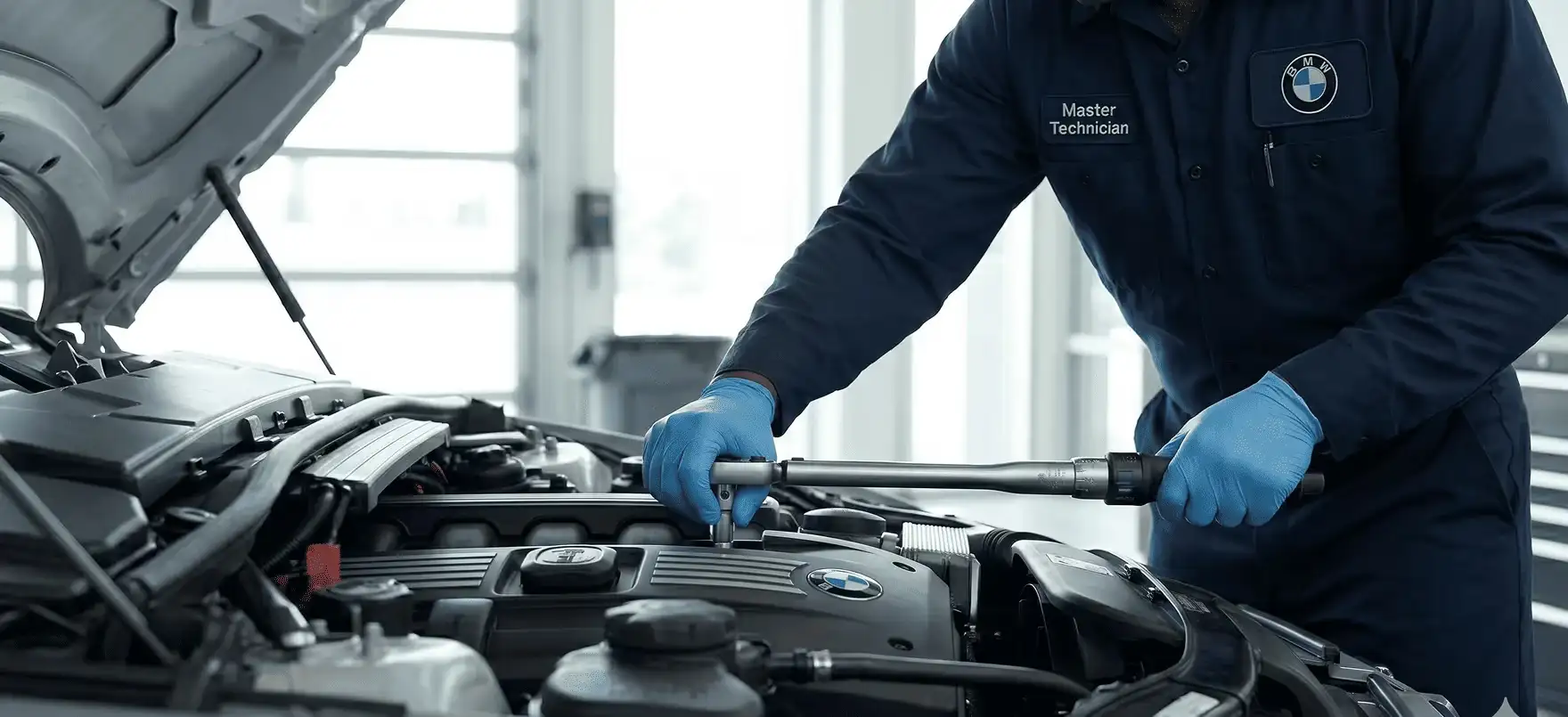
Caught on the first CBS warning, pads run $300 to $650. Wait longer and you'll need rotors and a new sensor too — closer to $1,000 or more. A brake inspection is free.
Published June 9, 2026
·Reviewed by
Robert Fowler, General Manager
·~10 min read
Front pads
$300–$650By model · genuine BMW pads + new wear sensor
Full brake job
$1,000–$1,600Pads + rotors · all four corners
CBS warning
2-stage systemYellow alert · then red · don't ignore
Same job, very different price — depending on when you catch it.
The reason a brake quote can swing from $300 to $1,600 on the same car is that BMW rotors are designed to last about as long as one set of pads — not two. Catch the wear at the first iDrive warning and you're replacing pads. Wait 2,000 or 3,000 miles past it and the rotors usually drop below their minimum thickness, so the same visit now needs pads, rotors, and a new wear sensor. The job didn't get bigger; the timing did.
On national benchmarks, BMW brake service runs $300–$1,600. Quick view by model tier:
3 Series or X3 front pads: $300–$475
X5, X7, or 5 Series front pads: $375–$650
Full pad-and-rotor job on an X5 or X7: $1,200–$1,600
The CBS warning gives you roughly 2,000–3,000 miles of usable runway after it pings. Use that runway and you pay the bottom of the range. Drive past it and you pay the top.
We don't publish a fixed menu. The right number depends on your VIN, your pad-sensor state, and whether the rotors are still serviceable. Call (678) 619-3081 and we'll quote it in writing before we touch the wheels.
The real lesson
1. On national benchmarks, a pad job done on time costs roughly a third of a pad-and-rotor job done late. The CBS warning gives you 2,000–3,000 miles of usable runway. Use it. Driving past the red warning turns a roughly $475 brake-pad ticket into roughly $1,350 with rotors.
2. "Genuine BMW" parts are made by Textar, Pagid, Brembo, and ATE, the primary OE suppliers BMW has used at the factory. The friction compound and the wear-indicator replacement are what we won't compromise on. Either gets done correctly, the car stops the way BMW engineered it to.
Service performed at BMW of South Atlanta, the authorized BMW retailer at 4171 Jonesboro Rd, Union City, GA 30291, 7.5 miles from Hartsfield-Jackson, serving metro Atlanta since 1999. Service department open Monday–Friday 7:30 AM–6:00 PM, Saturday 8:00 AM–4:00 PM. Parts: (678) 619-3082. Sales: (770) 954-7738.
02
What you'll pay
What brake service costs by model.
Most BMW brake service lands in three tiers: a 3 Series front-pad job runs $300–$450; an X5 with M Sport Brakes runs $400–$650; a full pads-and-rotors job on an X7 lands at $1,200–$1,600. Numbers by model below, sourced from RepairPal and the KBB Service Estimator. M Sport Brakes run 40–80% above standard; M Carbon Ceramics are quoted separately. Call (678) 619-3081 for your VIN-specific figure.
Pricing sourceRanges above are RepairPal and KBB Service Estimator national benchmarks for budgeting, updated May 2026. Trim names verified against current BMW USA model pages. Your actual quote comes from your VIN: brake package, pad/rotor wear, and model year all move the number. M5 sedan and X5 M Competition are quoted directly; M Sport Brakes and M Carbon Ceramic Brakes run significantly higher than the standard table.
Pricing varies by trim, brake configuration, and current pad/rotor wear. Schedule a written estimate or call (678) 619-3081 and we'll confirm the exact figure against your VIN before you authorize anything.
Why M340i xDrive costs more than a 330i
Same chassis, different brake hardware. The M340i runs the B58 inline-six with M Sport Brakes included — 4-piston fixed calipers and larger 348mm front rotors. The 330i (B48 four-cylinder) runs floating calipers and 312mm rotors. The bigger calipers and rotors on the M340i are what move the price up.
Why X5 outruns 3 Series
It isn't just larger rotors. The X5's curb weight (around 5,000 lbs in xDrive40i trim with the B58) demands more aggressive friction compounds and more pad surface area. The M Sport Brakes option (standard on M60i with the S68 V8) jumps to 395mm fronts with 4-piston calipers.
Why i4 and iX run lower
Regen does most of the deceleration work on an i4 or iX, so the pads barely get used — they don't see the heat or wear a gas BMW's pads do. Pad life runs much longer. The trade-off is rotor corrosion from underuse, which we cover below.
Want pricing on your specific VIN? Five-minute callback.
A small wire inside one front pad and one rear pad (usually front-left, rear-right) wears down with the pad. The iDrive system reads the resistance change and calculates how many miles you have left before service is due. That's why your BMW can warn you weeks in advance, instead of waiting until the pad is gone.
The system is two-stage:
Stage 1 (yellow warning). As the wire thins, its resistance climbs to about 270 ohms. The instrument cluster picks up on it and posts a CBS Brakes service due message in iDrive with the mileage to go. This is the plan-ahead alert — you usually have 2,000 to 3,000 miles of usable pad left from that point.
Stage 2 (red warning). The rotor has now severed the wire entirely and the circuit reads open. A red brake icon comes up, the pads are at minimum thickness, and the car needs to come in before you keep driving on it.
The sensors are one-time-use
Replace the pads, you replace the sensors. They can't be reused, heat and dust corrode the connectors, and BMW pad sets ship with new sensors for a reason. Front and rear sensors aren't interchangeable; the wire lengths and connector positions are different, and the ECU expects specific resistance values from each location.
The CBS reset is required
Even with new pads and a new sensor, the dashboard warning stays on until the CBS service reset is performed via the iDrive system. Independent shops without BMW-compatible diagnostic tools sometimes miss this. The customer drives away with a still-illuminated brake light and no idea why.
It reads driving pattern, not just the sensor
CBS estimates pad life based on wheel speed, brake pressure events, brake disc temperature data, and total brake-application time. Two identical X5s in identical condition can show different "miles to service" numbers because one driver brakes harder.
BMW Condition Based Service · the wear sensor and iDrive readout are checked together at every brake inspection — see our service department for a full CBS diagnostic.
04
Five warning signs
Five things to listen and feel for, even without a warning light.
Squealing, grinding, pedal pulsation, a long or soft pedal, or pulling to one side — these are the five things that warrant a brake inspection even without a CBS warning. The sensor only watches pad wear; warped rotors, moisture in brake fluid, and sticking calipers don't trigger it. Don't wait for the dashboard to ask first.
Metallic squeal under normal brakingThe pad material has worn low and the metal backing is starting to touch the rotor. BMW's wear indicator is an electronic sensor, not a mechanical tab, so a squeal is your ears catching what the sensor reads electrically — and sometimes you'll hear it before the dashboard says anything. Either way it's the same answer: book the inspection.
Grinding noiseThe pad material is gone and the steel backing plate is now eating the rotor. Call us: (678) 619-3081. Don't keep driving. On national benchmarks, every additional mile turns roughly a $400 pad replacement into roughly a $1,200 pad-and-rotor job, and beyond a certain point puts the caliper at risk.
Pulsation through the pedalUsually warped or unevenly worn rotors. Common after a single hard event — a long descent at high speed, repeated heavy braking on I-285. The fix is resurfacing or replacement; rotors don't return to true on their own.
Long, soft pedalBrake fluid problem. DOT 4 fluid absorbs ambient moisture even through sealed lines. Boiling point drops over time. On a hard stop the fluid can vaporize, the pedal goes long, stopping distance increases. BMW's two-year fluid replacement interval is non-negotiable on the maintenance schedule, regardless of mileage.
A pull to one sideSticking caliper or pads wearing unevenly across the axle. Get it inspected before it becomes a rotor problem too.
Brake symptoms get diagnosed under the lift, not in the parking lot — schedule an inspection if any of the five signs above sound familiar.
05
Why rears wear faster
Why your rear brake pads wear out as fast as the fronts.
If your quote only covers front pads, ask about the rears. On a BMW, they're usually due within a few thousand miles of the fronts — doing both at the same visit means one labor charge instead of two.
On most luxury crossovers, the front pads wear out at 35,000 to 40,000 miles and the rears last about twice as long. BMWs work differently. Your rear pads will keep pace with the fronts, and on some models they'll actually wear out first. This isn't a defect — BMW engineers the brake balance this way on purpose.
It's something we see often on the X3 and X5 platforms, which is why our technicians always check the rear pads whenever the fronts come off — on a BMW, they're usually due within a few thousand miles of each other.
The reason is BMW's Electronic Brake Force Distribution (EBD). Most mid-size luxury crossovers send roughly 70–80% of brake torque to the front axle. BMW pushes closer to a 60/40 front-rear split under normal braking, and more rearward under hard stops and cornering.
That's how BMW engineers the chassis on purpose. A rear-biased brake distribution gives the car its planted, neutral feel under hard stops. Sending most of the brake force forward makes the nose dive and lifts weight off the rear axle, which hurts stability.
Don't wait on the fronts before doing the rears. By the time the fronts are due on a BMW, the rears are within a few thousand miles of due too. One appointment, all four corners — one labor charge instead of two.
BMW of South Atlanta · Service department
Track-day owners see the rear-bias effect amplified
M Sport-equipped 3 Series and X3 drivers running canyon roads or HPDE events frequently see the rears wear out first. The chassis is doing exactly what it was tuned to do. M models with M Compound Brakes use different pad chemistry on the rear axle precisely to manage this.
Front rotors still cost more per corner
Larger diameter, more heat capacity, more material. On cars with M Sport Brakes (374mm front on standard X5, 395mm on M60i, 400mm on M5) the front rotor is the most expensive single brake part on the car.
06
OEM pads & rotors
What "Genuine BMW" parts really means.
BMW doesn't actually manufacture brake pads — the company assembles cars. The pads are made by suppliers like Textar, Pagid, Jurid, and ATE, and the rotors come from Brembo (especially on M models), ATE, or SHW. When you buy a set of pads in a Genuine BMW box, they came out of one of those supplier factories.
The pad inside a Genuine BMW box was made at the same factory, with the same friction compound and the same metallurgy as the one that came on your car from the assembly line. What you're paying for with the Genuine BMW label is the quality-control chain and the warranty coverage — not a different physical part.
Pads
OE Suppliers
Textar · Pagid · Jurid · ATE. The supplier mix shifts year to year — F30 3 Series came from Jurid in 2014, Pagid in 2018, same part number.
Rotors
OE Suppliers
Brembo (M models especially) · Zimmermann · ATE · SHW. Same metallurgy and minimum-thickness spec as the original equipment rotor.
The friction coefficient spec
BMW's ABS, DSC, and the variable brake-pressure logic in iDrive are all calibrated around a specific friction compound. A non-OEM pad with a slightly different friction curve doesn't make the car unsafe. It shifts the threshold of where DSC intervention starts.
On a daily-driver 330i, most owners won't notice. On an X5 M60i hauling a family at speed, the difference is the kind a driver notices in the moment they need the system most.
The wear sensor
A new pad with a reused sensor is asking for the system to misread or fail to alert. Replace the sensors with the pads.
The CBS reset
New pads, new sensor, no reset = a still-illuminated dashboard light and a system that won't track wear correctly until the next visit.
For an out-of-warranty BMW, the cost gap between genuine BMW and OEM-equivalent (Brembo, Zimmermann, ATE, Textar from a parts catalog) is usually $50 to $150 per axle on national benchmarks. We use genuine BMW as the default. If you'd rather go OEM-equivalent, ask when you book and we'll walk through the trade-off. Either way, the parts going on your car will meet the original specification.
07
Dealer or independent
Should you bring it to us, or an independent BMW shop?
The honest answer depends on what's actually on the visit. For routine pad-and-rotor work on an out-of-warranty BMW, a good BMW-specific independent will usually beat us on price. For warranty work, software updates, the CBS reset, or anything on an M car or an i Series, the dealer is the right place — those need BMW factory tools and trained labor that a generalist shop doesn't carry.
The five situations we see most often, with the honest recommendation for each:
When to choose a BMW dealer vs an independent BMW specialist
Your situation
Where to go
Why
Under warranty (4yr/50k or Ultimate Care 3yr/36k)
Dealer
Warranty work requires BMW-spec parts and BMW-trained labor. Brake fluid service is included under Ultimate Care.
4–10 years old, normal wear
Either
A reputable BMW-specific independent running OEM parts can do the job for less. The dealer advantage is chassis-level pattern recognition: the tech has seen the same car 80 times this year, not 5.
10+ years old, enthusiast owner
Independent / DIY
If you know what you're doing, an independent specialist or DIY can make sense at this stage of ownership.
M cars and i cars (any age)
Dealer
M Carbon Ceramic Brakes and i-series brake-by-wire systems require dealer-level diagnostic tools and software. Initializing a new pad set on an iX requires BMW's dealer-grade diagnostic tool (ISTA) and current software, standard equipment at an authorized BMW retailer.
Anything under BMW Value Service
Dealer
Genuine BMW parts at value pricing, 2-year unlimited-mileage parts warranty. As of March 2026, eligible for BMWs three years from in-service date, up to 20 years old, any chassis.
Cars under warranty
Dealer. The BMW New Vehicle Limited Warranty (4 years/50,000 miles) and BMW Ultimate Care (3 years/36,000 miles) require BMW-spec parts and BMW-trained labor for warranty work. Brake fluid service is included in Ultimate Care; pad and rotor wear is not.
Independent shops can do warranty-period work without voiding coverage under the Magnuson-Moss Act. But if a brake issue surfaces later that's tied to the work, the conversation gets complicated. Stay with the dealer while you're still in warranty.
Cars 4–10 years old, normal wear
Either works. A reputable BMW-specific independent — emphasis on BMW-specific, not a general luxury or German shop — running OEM parts can do the job for somewhat less.
The real difference is pattern recognition. A factory-trained BMW technician sees the same platforms repeatedly throughout the year. That builds the muscle memory to catch what a brake job often surfaces: a worn control arm bushing accelerating uneven pad wear on one corner, a sensor harness about to fail, or a thrust arm bushing that's the actual cause of the steering vibration the customer thought was brakes.
Cars over 10 years old, owner is a BMW enthusiast
Independent specialist or DIY may make sense if you know what you're doing. The N52, N54, and N55 inline-sixes from the E90 / F30 era have well-documented parts catalogs and active enthusiast communities. The pad and rotor specs haven't changed materially for those platforms.
M cars and i cars at any age
Dealer. M-specific brake hardware and i-series brake-by-wire systems require dealer-level diagnostic tools and procedures. Service on BMW M Carbon Ceramic Brakes — an optional upgrade on the M3 and M4 (S58-powered), and available on the current M2 (G87, S58), M5, and X5 M — requires the M-specific tooling and torque sequences carried by an authorized BMW retailer. The brake-by-wire ECU on an iX won't initialize a new pad set without a dealer-grade scan tool and the right software version.
Always at the dealer: BMW Value Service
Anything involving the BMW Value Service program comes back to the dealer. As of March 1, 2026, BMW NA expanded eligibility to any BMW three years from its in-service date, up to 20 years old, any model, any chassis (Source: bmwusaservice.com/valueservice, verified 2026-05-25). Genuine BMW parts at value pricing, backed by a two-year unlimited-mileage parts warranty. Confirm your VIN's eligibility on the BMW Value Service page before booking.
08
i4 and iX brakes
If you drive an i4 or iX, brakes work differently.
An i4 or iX brake quote often comes in lower than the gas-BMW ranges above — pads on these cars regularly last 80,000 to 120,000 miles because the electric motor handles most of the stopping. The trade-off is what we see almost every week on the service drive: the rotors rust because the pads barely touch them. That's the EV brake paradox, and it's why an i4 or iX needs annual inspection even when the pads look new.
The i4 and iX use brake-by-wire. When you press the pedal, the input goes to a computer, not directly to the master cylinder. The electric motor handles most of your stopping by acting as a generator. The friction brakes only engage when the motor can't slow the car enough on its own.
Two things follow from that:
Good news: pads can last 80,000 to 120,000 miles.
Watch for this: rotors can rust because the pads barely touch them on most drives.
Press the brake pedal in an i4 and the input goes to an electronic control unit, not directly to the master cylinder. The ECU decides how much deceleration the regen system can deliver and routes brake force accordingly. Light to moderate braking is handled entirely by the electric motor working as a generator, sending kinetic energy back to the high-voltage battery.
The friction brakes engage when regen capacity is exceeded: emergency stops, panic braking, ABS events, or when the battery is too cold or too full to accept additional charge.
Adaptive regen on the i4 and iX uses GPS and navigation data to anticipate stops. Approaching a known intersection or traffic-monitored slowdown, the system increases regen automatically. Pedal feel stays consistent because the brake-by-wire system continuously blends regen and friction to deliver the same deceleration the driver requested.
80–120k mi
Typical pad life on i4 / iX
2 yr
Brake fluid interval — same as gas
1 /yr
Recommended brake inspection cadence
DOT 4
Same hydraulic fluid spec
Pad life can run 80,000–120,000 miles
Some heavy city-commuter owners still have factory pads at 100k+. The friction system simply doesn't see the heat or pressure cycles a gas BMW's brakes do.
Rotor rust is a real, common problem
This is the EV brake paradox: less use means more corrosion. Rotors on an EV driven mostly in B mode (one-pedal driving) or heavy regen go for weeks without the friction surface ever seeing the pad. Rust forms.
Eventually the rust builds up past what a light brake application can clean off. You get pulsation, noise, or uneven pad bedding. A 4-year-old iX with 35,000 miles can need rear rotor replacement purely from corrosion, despite the pads being almost new.
The fix isn't a different driving habit
Switch off regen entirely and you lose the efficiency advantage that made you buy the EV. The right answer is annual brake inspection (which our techs can perform in 20 minutes) and replacing rotors when corrosion gets ahead of light scrubbing. We see this often enough on Atlanta-area iX and i4 cars that we have a standard inspection protocol for it.
How i4 / iX brake service differs from a gas BMW
Item
Gas BMW
i4 / iX
Pad life
40,000–60,000 mi (typical)
80,000–120,000 mi (regen reduces friction use)
Main wear risk
Pad/rotor wear from friction
Rotor corrosion — pads barely touch them
Brake fluid
DOT 4, every 2 years
DOT 4, every 2 years (same clock)
Inspection cadence
Per CBS warning
Annually — rotor corrosion doesn't trigger CBS
Caliper risk
Low with regular use
Slide pins seize when underused — check annually
Brake fluid is on the same two-year clock
No exceptions for EVs. The hydraulic system still uses DOT 4 fluid and the fluid still absorbs moisture from the air. Brake-by-wire systems are actually more sensitive to fluid quality than conventional systems — the ECU measures pressure response curves to detect faults, and degraded fluid affects those readings.
Caliper service is critical on EVs
Calipers that don't get exercised regularly seize. We'll often find one corner where the caliper slide pins have stiffened from corrosion, easily resolved with a service, expensive if it's missed and the pad wears unevenly.
The 8-year/100,000-mile high-voltage battery warranty covers the battery, not brake components. Brake wear items are owner-paid.
BMW STEP-certified technician on the Union City service drive — brake-by-wire diagnostics on the i4 and iX require BMW factory tooling.
09
Resurfacing rotors
Should the rotors be resurfaced or replaced?
For most BMWs, the answer is replace. Current BMW rotors ship from the factory close to their minimum safe thickness (that minimum is stamped right on the rotor hat). There usually isn't enough material left to surface without going below spec.
In practice, the rotors hit their limit around the same time the pads do, so we replace them together. There are a few cases where resurfacing makes sense — covered below.
Resurfacing is appropriate when
A car has been parked three months or more, with surface rust or light scoring on otherwise healthy rotors. A light surface pass cleans the friction surface without removing meaningful material.
An i4 or iX rotor has corrosion in early stages — rotor thickness still above minimum, pad still in spec.
A second pad cycle where the rotor was new at the previous service and is still well above minimum.
Replacement is required when
Thickness is at or below the minimum spec stamped on the rotor hat.
Visible scoring, deep grooves, or heat-induced cracking.
Lateral runout exceeds BMW's tolerance — the rotor wobbles, even slightly.
Pulsation persists after a fresh pad bedding-in cycle.
Option
Cost per rotor
When to choose it
Resurfacing
~$60–$120 labor
Surface rust or light scoring; rotor still above minimum spec; pad still has life.
Replacement
~$275–$650 parts + labor
At or below minimum thickness; deep grooves, cracking, or runout. Math usually favors replacement once labor is included — and the new rotor is good for another full pad cycle.
SourceResurface and replacement ranges above are national service-estimator benchmarks from RepairPal and the KBB Service Estimator (May 2026). BMW's rotor minimum-thickness specification is stamped on the rotor hat and measured at every brake job. Final figures are issued in writing per VIN at BMW of South Atlanta.
Rotor minimum-thickness is stamped on the hat — measured at every brake job. Ask our service team whether resurfacing or replacement is right for your VIN.
10
What's included
What's included in our brake quote that usually isn't elsewhere.
The headline items on our brake quote include free airport drop-off through Park'N Ticket, a multipoint inspection with video of your actual rotors and pads, mobile service for fluid jobs, same-day appointments on most pad/rotor work, and a loaner for anything that runs long. None of these are extras you opt into — they're how the brake job works at BMW of South Atlanta. The five worth knowing about in detail are below.
Free Hartsfield-Jackson airport conciergeDrop your BMW at Park'N Ticket on your way to the airport, tell the attendant it's scheduled for service, and we transport it to the dealership while you fly. Service runs while you're away. Car returns to Park'N Ticket — washed, ready — for your arrival. We're a mile from ATL. See full details on our airport concierge program.
Multipoint inspection with video documentationEvery brake service includes a video walkaround from the technician — footage of the actual pad thickness, rotor surface, caliper condition, and any other findings. You review the footage before authorizing additional work.
Mobile serviceFor a brake fluid service, pad inspection, or some pad replacement work, our technicians can come to you — your home, office, or anywhere within our metro Atlanta service radius. Schedule through our BMW mobile service page.
Same-day appointmentsFor most brake work, when the parts are in stock. Our parts inventory is sized for the Atlanta-area BMW population. Pads and rotors for the common service jobs are usually on the shelf.
Loaner vehiclesFor jobs that take longer than a few hours. M-car owners often appreciate this — we'll put you in something interesting while we work on yours.
Brakes feel different than they did six months ago? Bring it in.
The service team at BMW of South Atlanta — 4171 Jonesboro Road in Union City, about 7.5 miles from the airport. We've been an authorized BMW dealer at this address since 1999. Reviewed by Gianni Marini, our Service Director. Last verified: .
How we researched this article
This article combines national pricing benchmarks (RepairPal and Kelley Blue Book Service Estimator) with the service procedures and program terms we actually use on our Union City service drive. Editorial drafts were reviewed by our Service Director, Gianni Marini, for accuracy on BMW Ultimate Care, BMW Value Service, BMW Maintenance Schedule, and CBS procedures — cross-referenced against current BMW of North America documentation as of the date above.
Every price range shown is a planning number, not a quote. Final figures are written against your VIN before any work begins. If you spot a factual error, email our service team and we'll correct and re-verify.
The service department is led by Service Director Gianni Marini and Service Manager Alfred Roberts, supported by BMW STEP-certified technicians who train continuously on BMW's diagnostic and repair procedures. We honor BMW Ultimate Care complimentary maintenance under warranty and quote in writing before any non-warranty work begins.
A 3 Series brake job and an X5 brake job aren't the same line item — different rotors, different calipers, different pad sets. The other thing that moves the price is how soon you bring it in after the warning. Catch it at the yellow alert and you're usually paying for pads. Wait until it's metal-on-metal and you're paying for pads, rotors, and the sensor. Either way, we put the number in writing before we touch the wheels.
BMW of South Atlanta Service Team
After being snubbed all over Macon with my trade, I took the drive to Union City. They gave me what my BMW was worth and fixed me up with a great BMW 328i lease. I was treated fairly.
Verified customer, Macon, GA — published on the BMW of South Atlanta testimonials page
11
The questions buyers ask
Questions we get asked most often.
How much does BMW brake service cost in Atlanta?
BMW brake service in Atlanta runs approximately $300 to $650 for front pad replacement and $275 to $550 for rear pads, per national service-estimator benchmarks (RepairPal / KBB Service Estimator class). A full four-corner pads-and-rotors job on an X5 or X7 runs approximately $1,200 to $1,600. The 3 Series and X3 sit at the lower end; the X5, X7, and 5 Series at the upper. M Sport Brake packages typically run 40–80% more than the standard package.
Final quotes come off your VIN, not a generic menu. Call (678) 619-3081 for your written, VIN-specific quote.
How long do BMW brake pads actually last?
40,000–60,000 miles in normal mixed driving on a gas BMW. Closer to 30,000–45,000 on aggressive drivers, M Performance models, or anyone who lives on the highway. On an i4 or iX, regen does most of the deceleration work and pads can last 80,000 miles or more — sometimes well past 100,000. Track use and HPDE events shorten everything.
The CBS warning will tell you when to schedule. Easy rule of thumb: if you don't know how old your pads are, you're probably due for an inspection.
Should I replace pads and rotors at the same time, or do pads first?
Together, on most BMWs. The rotors are engineered close to their minimum thickness spec — they're not designed for two pad cycles the way some competitor brands are. By the time the pads are worn out, the rotor is usually close to minimum thickness too.
Doing pads only, then rotors later, often costs more because you pay the labor twice. Exception: if your rotors were replaced recently and have substantial life left, pads-only is fine.
Can my brake warranty work be done at an independent shop?
Yes legally, the Magnuson-Moss Warranty Act protects you from automakers requiring dealer-only service to keep a warranty valid. But for a brake issue that surfaces later and might be tied to the previous work, the conversation is significantly cleaner if the work was done at the dealer. For warranty-period brake work specifically, the dealer is the simpler path.
Is BMW Value Service worth it?
Almost always, if your car qualifies. The BMW Value Service program is open to any BMW three years from its in-service date, up to a 20-year maximum (per the March 1, 2026 BMW NA program expansion; Source: bmwusaservice.com/valueservice verified 2026-05-25). You get genuine BMW parts and a factory-trained technician at value pricing, with a two-year unlimited-mileage parts warranty.
For brake work, it's typically priced in line with what a quality BMW-specific independent would charge — with the dealer's diagnostic tools, OEM parts supply chain, and warranty backing included.
Why does BMW recommend brake fluid replacement every two years?
BMW's two-year brake fluid interval is the engineering threshold below which the brake system stops performing to spec, not a conservative buffer. Brake fluid is hygroscopic — it absorbs moisture from the air over time, even through sealed brake lines. Water in the fluid lowers the boiling point. Under sustained hard braking (long descents, repeated highway stops), old fluid can vaporize, the pedal goes long, and stopping distance increases.
Brake fluid service is included in BMW Ultimate Care for the first 3 years/36,000 miles (Source: bmwusaservice.com/ultimatecare verified 2026-06-09). After Ultimate Care, the service runs approximately $120 to $300 on national service-estimator benchmarks — the low end is a standalone fluid replacement on 3 Series / X3 / Value Service pricing, the high end is 5 Series / X5 / X7 or when the fluid replacement is bundled with other 2-year items (Source: RepairPal + KBB Service Estimator, May 2026). EVs are on the same two-year clock — the friction brakes see less use, but the fluid ages the same way.
My i4 has 30,000 miles and the pads are nearly new. Do I still need brake service?
Yes. Pads aren't the issue on an EV — rotor corrosion is. Rotors that don't see regular friction use develop surface rust that, beyond a certain point, won't clean off with normal braking.
We'll inspect the rotor surface, the caliper slide pins (which seize when underused), and the brake fluid (which ages on the same calendar regardless of mileage). Annual inspection is what every i4 and iX should be on, even if the pads look new.
12
Provenance
Sources & references
Last reviewed and fact-verified · May 21, 2026
Authored by the BMW of South Atlanta editorial team and reviewed for technical accuracy by Robert Fowler, General Manager. The service department is led by Service Director Gianni Marini and Service Manager Alfred Roberts, supported by BMW STEP-certified technicians. Service procedures, pricing ranges, and BMW-specific brake engineering details verified against current BMW of North America documentation and the dealership's published service workflow as of the date above. BMW of South Atlanta has been the authorized BMW retailer just south of Hartsfield-Jackson since 1999, part of SONS Auto Group, BBB-accredited since May 25, 2007.
Service prices are quoted on a per-VIN basis at the time of inquiry. Call (678) 619-3081 with your model year, model, and mileage for an immediate quote, or see our BMW of South Atlanta FAQ for the most-asked ownership questions.
Call with your VIN for a written quote and the next available slot, or drop the car at Park'N Ticket on your way to the airport, we'll handle the rest.